First Torii 一ノ鳥居
Official explanation
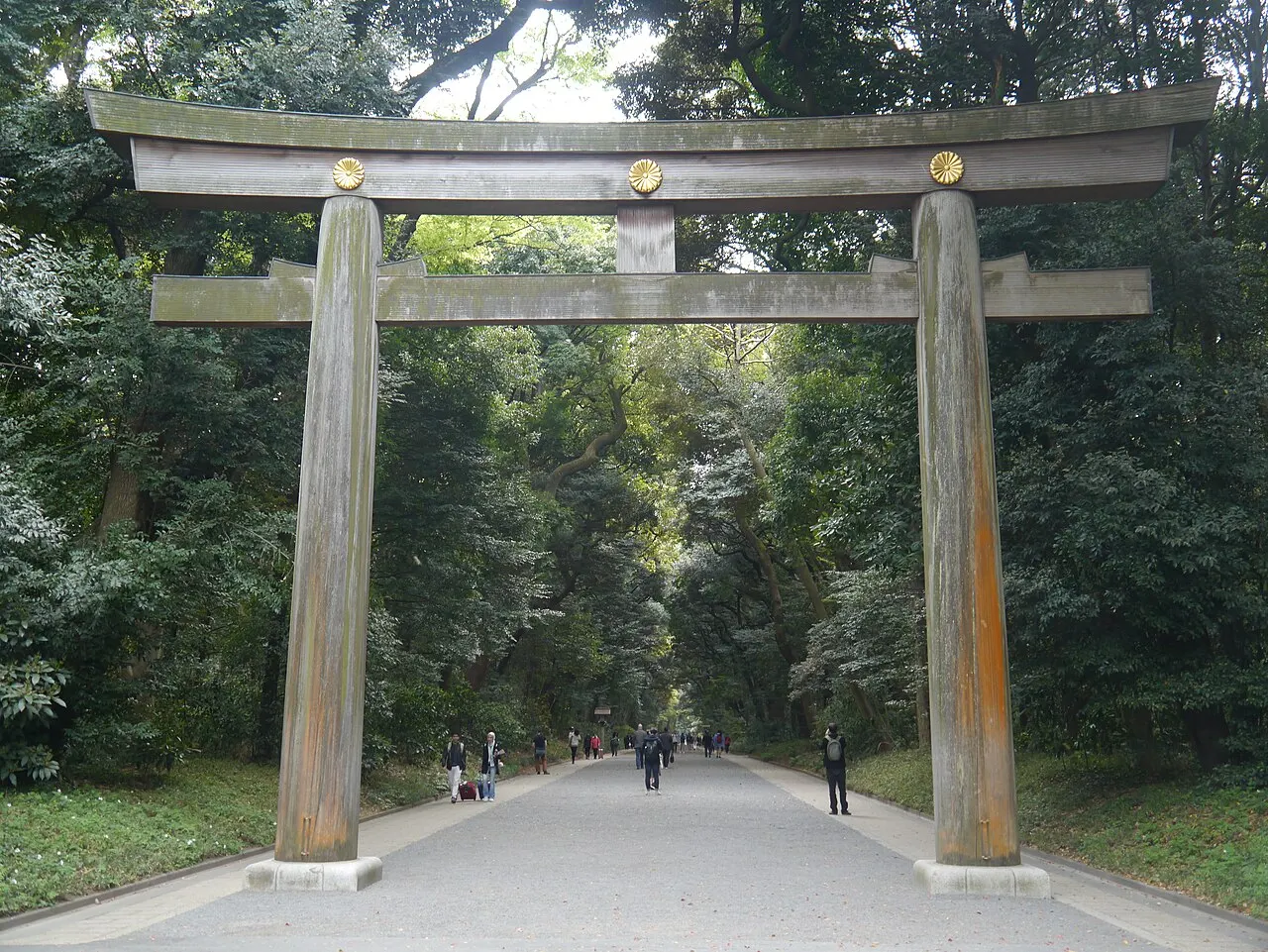
The First Torii gate marks the start of the main approach to Tsurugaoka Hachimangu along Wakamiya Oji Avenue. The torii spans the road about 500 meters from the ocean and is, at 8.5 meters tall, the largest of the three torii gates along the 1.8-kilometer avenue that is the main thoroughfare running through the heart of the city. The avenue was built by Minamoto no Yoritomo (1147–1199), the founder of the Kamakura shogunate, who wanted to model his capital—the new center of power in Japan—on Kyoto, the imperial capital. In Kyoto, a central avenue named Suzaku Oji led through the city from the south to the imperial palace, and Yoritomo had this pattern replicated in Kamakura, with the Wakamiya Oji terminating at Tsurugaoka Hachimangu. The First Torii was completed in 1180, followed by Wakamiya Oji in 1182. The torii has been rebuilt several times.
According to legend, the current stone torii was constructed on the initiative of Eyo (also Oeyo; 1573–1626), the wife of second Tokugawa shogun Tokugawa Hidetada (1579–1632). The deity Hachiman came to her in a vision and promised that in exchange for building a great torii, she would be blessed with a son. Eyo and the shogun had high-quality granite brought from faraway Bizen Province (present-day Okayama Prefecture). Ferrying the stone by sea to Kamakura and building the torii proved to be very time-consuming and the work was often interrupted. Eyo did have a son, Iemitsu (1604–1651), who succeeded his father as the third shogun, but the project was not finally completed until 1668, when Hidetada and Eyo’s grandson Tokugawa Ietsuna (1641–1680) was the fourth Tokugawa shogun. The great stone torii is designated an Important Cultural Property.
Read the full explanation
The First Torii gate marks the start of the main approach to Tsurugaoka Hachimangu along Wakamiya Oji Avenue. It spans the road about 500 meters from the ocean and is, at 8.5 meters tall, the largest of the three torii gates along the route. According to legend, the stone torii was built on the initiative of Eyo (also Oeyo; 1573–1626), the wife of shogun Tokugawa Hidetada (1579–1632), after the deity Hachiman came to her in a vision and promised that in exchange for building a great torii, she would be blessed with a son. Eyo and her husband had high-quality granite brought from faraway Bizen Province (present-day Okayama Prefecture). However, ferrying the stone by sea to Kamakura and building the torii was an extremely time-consuming undertaking. Although Eyo did have a son, Iemitsu (1604–1651), who succeeded his father as the third shogun, the project was not completed until 1668, when Hidetada and Eyo’s grandson Tokugawa Ietsuna (1641–1680) was shogun. The torii is designated an Important Cultural Property.
出典: 地域観光資源の多言語解説文データベース(観光庁) — www.mlit.go.jp/tagengo-db. この英語解説文は観光庁の地域観光資源の多言語解説整備支援事業で作成しました。
Source: Japan Tourism Agency, Multilingual Explanation Database. This English text was produced by the Japan Tourism Agency's multilingual explanation project and is shown unedited. Opening hours and services may have changed since it was written.
旅Kamakura tours
Live prices and reviews from GetYourGuide. Many tours can be cancelled for free — check each listing.
Ad: we may earn a commission if you book through these links, at no extra cost to you.
Things you may see here
 Torii gate鳥居
Getting there
Hotels in Kanagawa
Ad: we may earn a commission if you book through these links, at no extra cost to you.
More sites in Kanagawa
撮Standing in front of one?Open the scanner and compare →