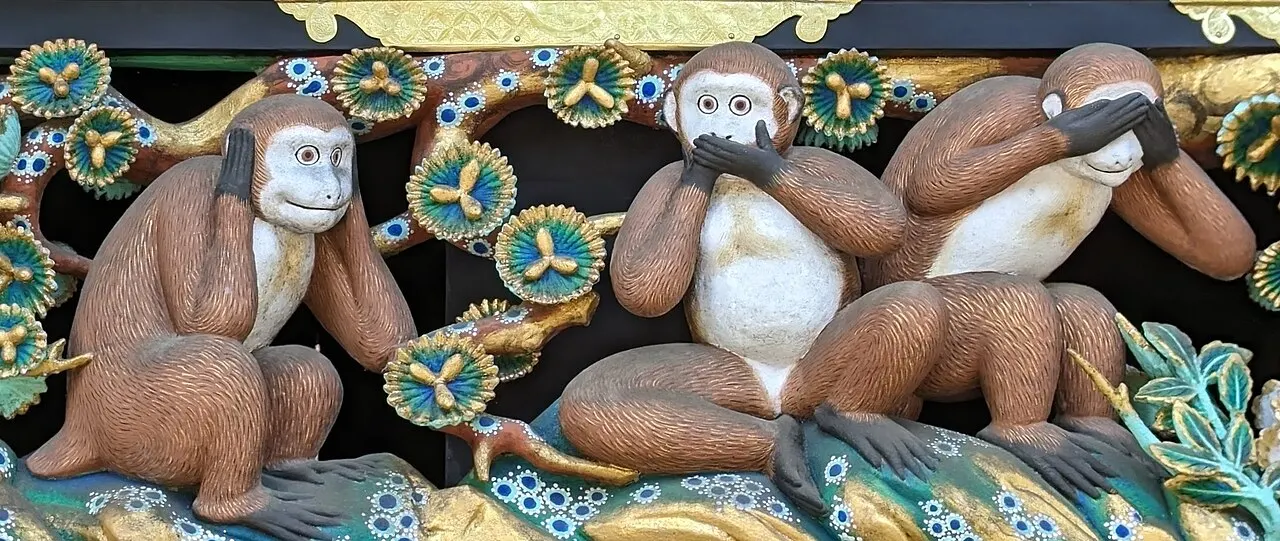
 三猿
Nikkō Tōshō-gū · 5 min read
The Three Wise Monkeys Are Only One Panel of a Life Story
The see-no-evil monkeys at Nikkō Tōshō-gū are the second of eight carved panels on the sacred stable. Here is how to find them and read the whole story.
✓ Fact-checked 2026-11-08 · how we check
文A Summary in your language
日本語
日光東照宮の「見ざる・言わざる・聞かざる」は、神馬をつなぐ神厩舎(しんきゅうしゃ)に彫られた8面の猿の彫刻のうちの2面目。8面は猿の一生をたどる物語とされ、三猿は「幼いうちは悪いものを見せず・聞かせず・言わせない」という子育ての場面と説明されます。猿は馬を守ると伝えられ、それで馬屋に猿が彫られています。
繁體中文
日光東照宮的「不看、不說、不聽」三猿,是神廄舍上八面猴子雕刻中的第二面。八面雕刻被解讀為猴子的一生,三猿代表「年幼時不讓孩子看、聽、說壞事」的育兒場景。日本自古相傳猴子能守護馬,因此馬廄上刻有猴子。
简体中文
日光东照宫的“不看、不说、不听”三猿,是神厩舍上八面猴子雕刻中的第二面。八面雕刻被解读为猴子的一生,三猿代表“年幼时不让孩子看、听、说坏事”的育儿场景。日本自古相传猴子能守护马,因此马厩上刻有猴子。
한국어
닛코 도쇼구의 "보지 않고, 말하지 않고, 듣지 않는" 세 원숭이는 신마를 두는 신큐샤에 새겨진 8면의 원숭이 조각 중 두 번째 면입니다. 8면은 원숭이의 일생을 그린 이야기로 해석되며, 세 원숭이는 "어릴 때는 나쁜 것을 보거나 듣거나 말하지 않게 한다"는 육아 장면으로 설명됩니다. 원숭이가 말을 지킨다는 전승 때문에 마구간에 원숭이가 새겨져 있습니다.
This story contains affiliate links. If you book through them, we may earn a commission at no extra cost to you.
Quick answer
The famous "see no evil, hear no evil, speak no evil" monkeys are only the second of eight carved panels on the sacred stable at Nikkō Tōshō-gū. Read together, the panels follow a monkey's life from birth to parenthood — and the three monkeys stand for childhood.
一Where to find them
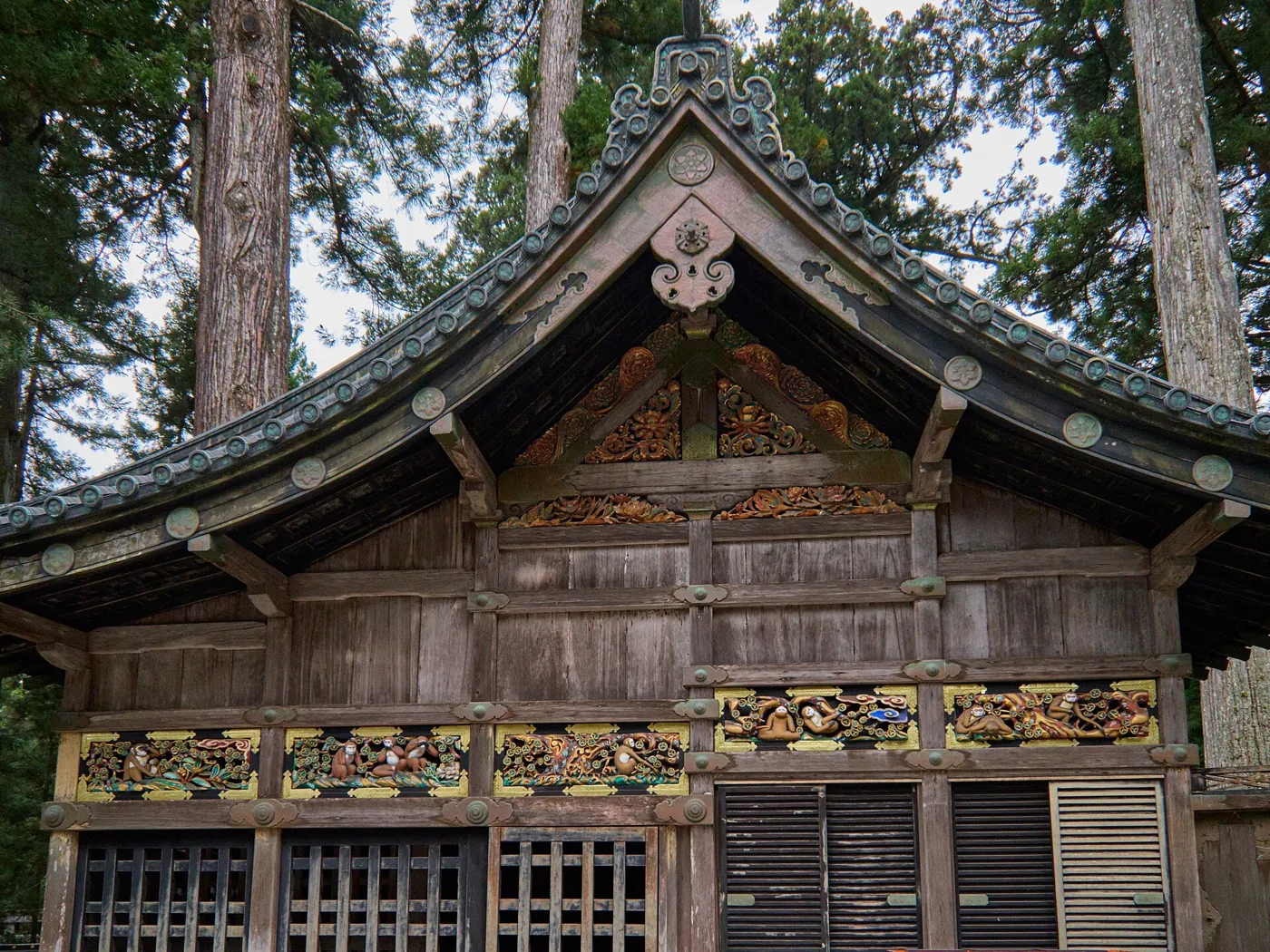
The monkeys are carved on the Shinkyūsha (神厩舎), the sacred stable. It sits in the first courtyard of Tōshō-gū, after the Omotemon gate and before the steps up to the golden Yōmeimon Gate.
- Pass through the Omotemon gate.
- Look for a low building of plain, unpainted wood — quiet next to the colourful halls around it.
- Look up at the band of carvings under the roof. Face the stable from the path: the three monkeys are on the second panel from the left.
There are usually crowds right here. Step back a few metres and you will see more than the people pressed against the rope.
二Why monkeys on a horse stable?
In Japanese lore, monkeys protect horses. Since early times they were linked with keeping horses healthy, so they became a natural decoration for a stable.
This is no ordinary stable. The shrine keeps a sacred horse, called shinme (神馬), a horse offered to the kami — a god or spirit in Shinto. The horse is not always there, so do not be disappointed if the stall is empty. If it is in, please do not feed or touch it.
三Read the eight panels in order
The panels run around the outside of the building, so walk all the way round. The usual reading, counted from the left as you face the stable from the path, goes like this:
- A mother and her baby. The mother shades her eyes and looks into the distance — towards her child's future.
- The three monkeys. Childhood. While children are young and easily influenced, keep bad things from their eyes, ears and mouths.
- A young monkey alone. Growing up and standing on its own.
- Looking up at a blue cloud. A young adult with big ambitions.
- At the edge of a cliff. A setback — and a friend who offers comfort.
- Lost in thought. The confusion of falling in love.
- A couple in rough waves. Facing life's storms together.
- A pregnant monkey. A new life begins, and the story returns to the first panel.
So the trio is not a rule about ignoring wrongdoing. In this reading it is advice for raising a child.
The Japan Tourism Agency's guide to the stable sums it up simply: the panels show "the circle of life."
四The word game hidden in the names
In Japanese the trio is mizaru, kikazaru, iwazaru — "not seeing, not hearing, not speaking." The old negative ending -zaru sounds like saru, the word for monkey.
That is why the saying is shown with monkeys at all: the pun is built into the language. Look closely at panel 2 and you will see which monkey covers which — ears, mouth and eyes.
五While you're here
The stable is the first of Tōshō-gū's famous carvings. Keep your eyes up as you walk on:
- The imagined elephants on the upper storehouse, carved by an artist who had never seen a real elephant.
- The golden Yōmeimon Gate, crowded with carved figures.
- The sleeping cat above the gateway on the way to the tomb of Tokugawa Ieyasu, with sparrows on the back.
探Found the monkeys? More hidden details are waiting
Open the hunt for Nikkō Tōshō-gū →
How to see it
| Where | Nikkō, Tochigi — first courtyard of Tōshō-gū |
| Hours | 8:00–17:00 (Nov–Mar until 16:00) |
| Entry | ¥1,600 adults (shrine entry) |
| Time needed | 15 minutes for the stable; 2–3 hours for the shrine |
Hours and fees can change. Check the official Nikkō Tōshō-gū website before you go.
Keep reading
- The Sleeping Cat of Nikkō: What Is It Really Guarding?
- The Great Torii of Miyajima Isn't Buried — So How Does It Stand?
Sources
- Japan Tourism Agency, Multilingual Commentary Database: Three Monkeys (Important Cultural Property) — https://www.mlit.go.jp/tagengo-db/en/R2-00011.html
- Japan Travel: Toshogu Shrine Sacred Carvings — https://en.japantravel.com/tochigi/toshugu-shrine-nikko/1561
- Tabiiro: The Meaning and History of the Three Wise Monkeys — https://en.tabiiro.travel/activities/article/nikko-three-monkeys/
- Japan Trails: Three Wise Monkeys at Nikko Toshogu — https://japan-trails.com/media/three-wise-monkeys-nikko-toshogu/
- Tabi-mag: Nikkō Tōshō-gū Shinkyūsha (Japanese) — https://tabi-mag.jp/tg0207/
- Kanshudo: Monkey in Japanese (the -zaru wordplay) — https://www.kanshudo.com/grammar/monkey-in-japanese
- Visit Nikko: Nikko Toshogu Shrine (hours and fees) — https://visitnikko.jp/spots/nikko-toshogu-shrine/