 七五
Japan · 5 min read
What Is Shichi-Go-San? Japan's 7-5-3 Day for Children, Explained
Shichi-Go-San is Japan's mid-November shrine visit for children aged three, five and seven. Learn what it means, why the candy is so long, and how to watch politely.
✓ Fact-checked 2026-11-09 · how we check
文A Summary in your language
日本語
七五三は、3歳・5歳・7歳の子どもの成長に感謝し、これからの健康を祈って神社にお参りする行事。日は11月15日ですが、今は11月の週末や祝日に行く家族が多いです。千歳飴は「千年」の名と細長い形に長生きの願いがこめられています。11月15日になった理由は、徳川綱吉の子の祝いからと伝えられます(伝説)。
繁體中文
七五三是為3歲、5歲、7歲的孩子感謝成長、祈求健康而參拜神社的傳統活動。日子是11月15日,但現在許多家庭會在11月的週末或假日前往。千歲飴的名字意為「千年」,細長的形狀寄託長壽的願望。相傳定在11月15日源於德川綱吉為兒子祝賀(傳說)。
简体中文
七五三是为3岁、5岁、7岁的孩子感谢成长、祈求健康而参拜神社的传统活动。日子是11月15日,但现在许多家庭会在11月的周末或假日前往。千岁饴的名字意为“千年”,细长的形状寄托长寿的愿望。相传定在11月15日源于德川纲吉为儿子祝贺(传说)。
한국어
시치고산은 3세·5세·7세 아이의 성장에 감사하고 앞으로의 건강을 빌며 신사에 참배하는 행사입니다. 날짜는 11월 15일이지만, 지금은 11월 주말이나 공휴일에 가는 가족이 많습니다. 지토세아메는 "천 년"이라는 이름과 가늘고 긴 모양에 장수의 소망이 담겨 있습니다. 11월 15일이 된 이유는 도쿠가와 쓰나요시의 아들 축하에서 비롯되었다고 전해집니다(전설).
This story contains affiliate links. If you book through them, we may earn a commission at no extra cost to you.
Quick answer
Shichi-Go-San ("seven-five-three") is a family visit to a Shinto shrine to give thanks that a child has reached the age of three, five or seven, and to pray for the child's health. The traditional day is November 15, but today most families go on a weekend or holiday sometime in November.
一Who celebrates, and when
The ages are fixed, but who celebrates at each age depends a little on the region:
| Age | Who |
|---|---|
| 3 | Girls and boys (in some regions, girls only) |
| 5 | Boys |
| 7 | Girls |
Families visit their local shrine — traditionally the shrine of the ujigami, the kami who protects the neighbourhood. (A kami is a god or spirit in Shinto.) Some families visit a Buddhist temple instead.
Shichi-Go-San is not a public holiday. That is why the busiest days are the weekends just before and after November 15.
二Three old milestones in one day
Shichi-Go-San grew out of three separate coming-of-age customs. Long ago they were held by court nobles and samurai families:
- Age 3 — kamioki: letting the child's hair grow long for the first time.
- Age 5 — hakamagi: a boy wears hakama, wide pleated trousers, for the first time.
- Age 7 — obitoki: a girl ties her kimono with a full obi sash instead of simple cords.
In times when many children did not survive infancy, reaching these ages was a real reason to thank the kami. The custom spread to merchant families in the Edo period, and from the Meiji era (1868–1912) to ordinary families across Japan.
三How to spot a Shichi-Go-San family
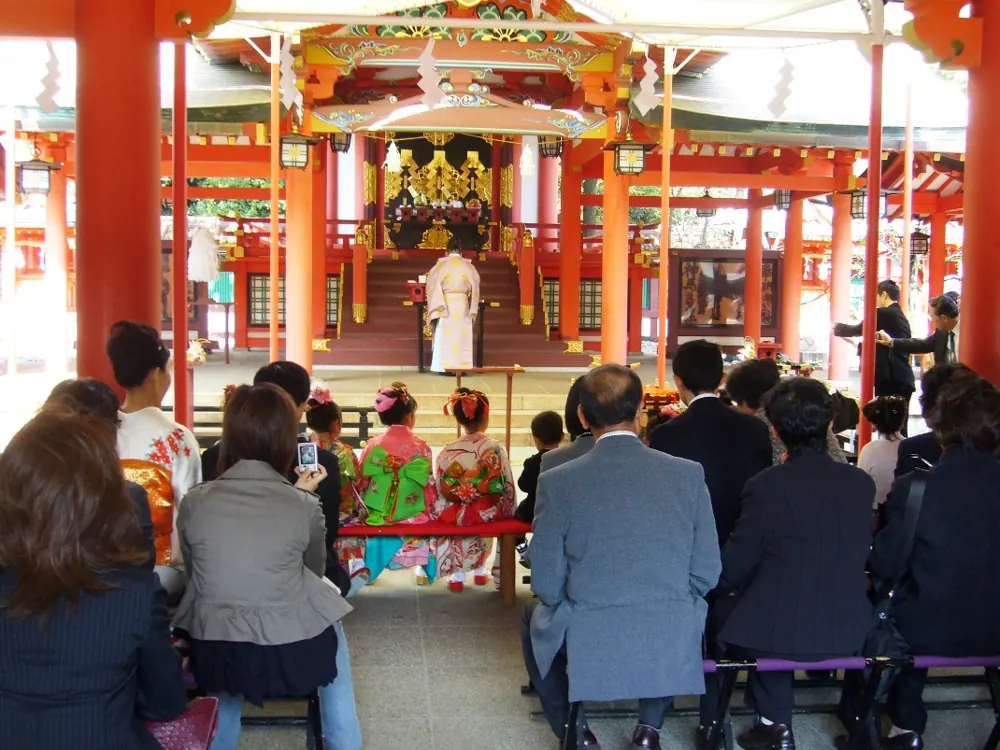
On a sunny November weekend at a large shrine, you will notice them right away:
- Small children in formal kimono. Three-year-olds often wear a padded, sleeveless vest called a hifu over their kimono.
- Five-year-old boys in hakama with a haori jacket — a miniature version of men's formal dress.
- Seven-year-old girls in a long-sleeved kimono tied with a full obi, often with hair ornaments.
- Parents and grandparents in suits, kimono or smart clothes, and a lot of photographs.
Not every family wears kimono. Western-style suits and dresses are common too, and some families simply take studio portraits.
Many families also ask for a private prayer inside the shrine hall. Watch from outside, quietly.
四Why is the candy so long?
Look for children carrying a long paper bag. Inside is chitose-ame (千歳飴), "thousand-year candy" — thin red and white sticks of sweet, chewy candy.
The name and the long, stretched shape carry a wish that the child will live a long and healthy life. The bags are printed with cranes and turtles, both symbols of long life in Japan, and often pine, bamboo and plum too. Some shrines give the candy to families after the prayer; it is also sold in shops in November.
五If you are in Japan in November
Shichi-Go-San is not a ticketed event. Families simply visit shrines through the month, so you may meet them at any shrine on a November weekend.
Visit the shrine as you normally would: rinse your hands at the water basin, pray at the offering box, and let the families go first at busy spots.
How to see it
| When | Around November 15; busiest on November weekends and holidays |
| Where | Shinto shrines across Japan, large and small |
| Entry | Shrine grounds are usually free to enter |
| Time needed | 30–60 minutes at a shrine |
Prayer times and ceremony details differ by shrine. Check the official website of the shrine you plan to visit.
Keep reading
- Why Do Inari Foxes Hold Keys? And Who Paid for 10,000 Torii?
- 3,000 Lanterns and Sacred Deer: Kasuga Taisha Explained
Sources
- Kokugakuin University, Basic Terms of Shinto: Shichi-go-san — https://d-museum.kokugakuin.ac.jp/bts/detail/?id=3933
- Nippon.com, Japan Glances: Shichi-Go-San — https://www.nippon.com/en/features/jg00043/shichi-go-san.html
- Embassy of Japan in Singapore, Japan Creative Centre: Shichigosan (Nov 2021) — https://www.sg.emb-japan.go.jp/JCC/E-Magazine-Nov-2021-Shichigosan.html
- Tokyo Weekender: The story behind Shichi-Go-San — https://www.tokyoweekender.com/art_and_culture/history/the-story-behind-the-japanese-custom-of-shichi-go-san-seven-five-three/