Treasure House 輪王寺宝物殿
Official explanation
The Treasure House is the repository for approximately 30,000 artifacts dating back 1,250 years, including one National Treasure (a group of 59 handscrolls), 51 Important Cultural Properties, and seven Important Art Objects. The gallery holds regular exhibits of about 50 artifacts at a time, in addition to special exhibitions. The Treasure House was built in 1984 on the site of the former Honbō, which was the abbot’s residence and the main administrative quarters of the temple.
Fūjin and Raijin
Read the full explanation
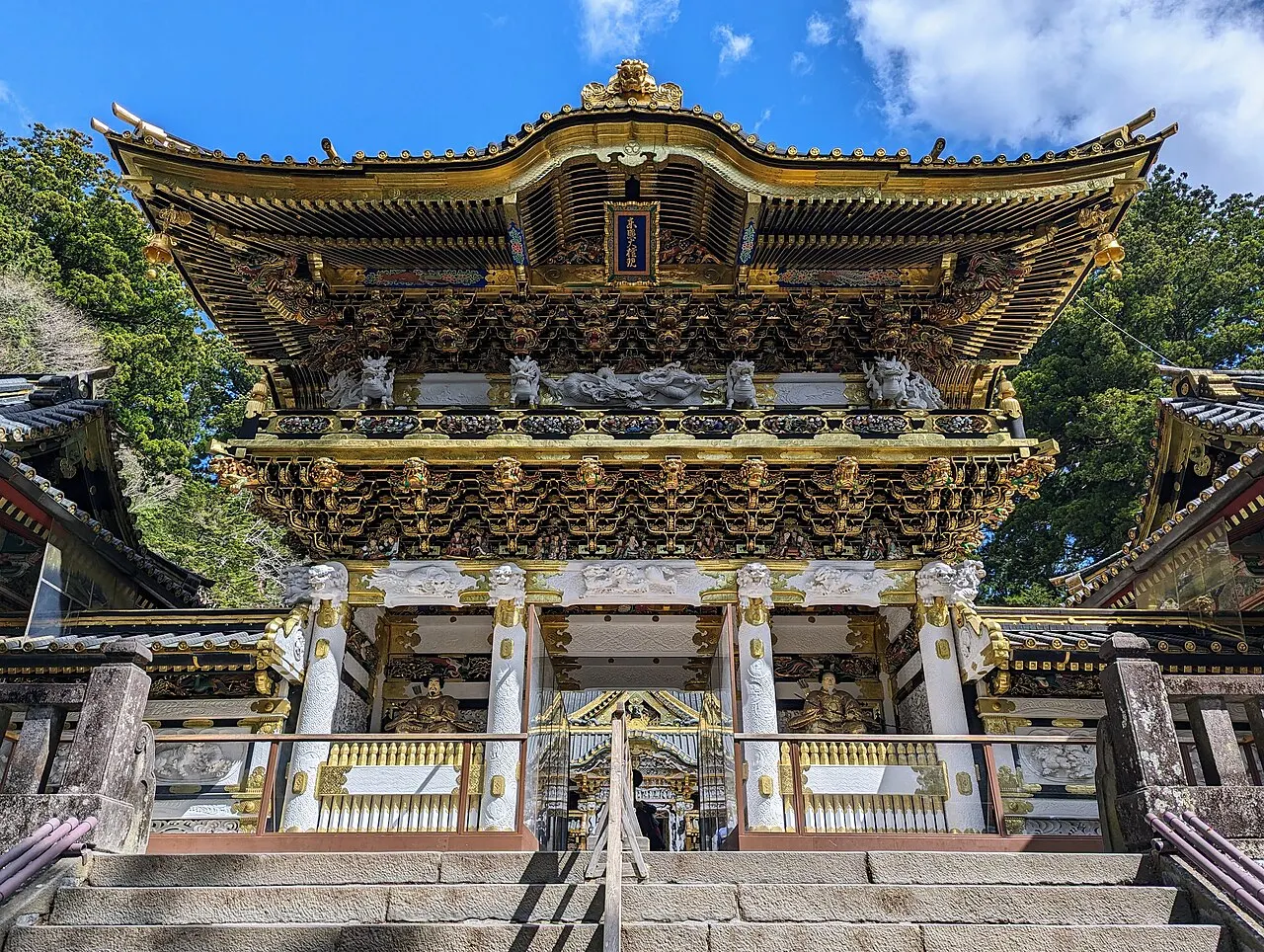
Fūjin, the wind god, and Raijin, the thunder god, are siblings and usually depicted as a pair. They are thought to protect Senju Kannon and to cause, as well as protect against, storms and disease. These statues are from the seventeenth century. They originally stood in the bays of the Yōmeimon Gate of Tōshōgū Shrine and later in the Nitenmon Gate of the Taiyūin Mausoleum.
Senju Kannon (Important Cultural Property)
Senju Kannon (Thousand-Armed Bodhisattva of Compassion) is one of the three main deities venerated at Rinnōji and is said to be incarnate in the form of Mt. Nantai. This image is thought to have been the Buddhist half of a Shinto-Buddhist pair, and it may have been the reverse side of a mirror. It was cast from a copper alloy in the twelfth century. The design of trailing vines and chrysanthemums was common on mirrors from that time but was rarely incorporated into the halo of light which surrounds a Buddhist deity as it is here.
Shōyōen Garden
This garden dates from the early seventeenth century. It was originally part of the Honbō, or abbot’s quarters, when Rinnōji’s abbots were imperial princes. The pond was designed to evoke Lake Biwa, northeast of Kyoto. It would have presented a familiar sight for the abbot and monks of Rinnōji, since Lake Biwa is near Mt. Hiei, which is the location of Enryakuji, head temple of the Tendai school of Buddhism. The design incorporates views of Mt. Nakimushi to the south, Mt. Nantai to the west, and Mt. Nyohō and Mt. Akanagi to the north. After a major renovation in 1815, the garden underwent further renovations in the Meiji era (1868–1912).
出典: 地域観光資源の多言語解説文データベース(観光庁) — www.mlit.go.jp/tagengo-db. この英語解説文は観光庁の地域観光資源の多言語解説整備支援事業で作成しました。
Source: Japan Tourism Agency, Multilingual Explanation Database. This English text was produced by the Japan Tourism Agency's multilingual explanation project and is shown unedited. Opening hours and services may have changed since it was written.
旅Nikkō tours
Live prices and reviews from GetYourGuide. Many tours can be cancelled for free — check each listing.
Ad: we may earn a commission if you book through these links, at no extra cost to you.
Treasure hunts nearby
Getting there
Stay in Nikkō or Kinugawa Onsen
Ad: we may earn a commission if you book through these links, at no extra cost to you.
More temples in Tochigi
Open the scanner and compare →