Nikkōzan Rinnōji Temple 日光山 輪王寺
Official explanation
“Nikkōzan” refers to the entire religious community that lives and worships at the temples and shrines in the mountains of Nikkō. Buddhism and Shinto had been fused for over 1,000 years, but this ended in the late nineteenth century when they were separated by order of the Japanese government.
The name “Nikkō” is said to have been suggested by the famous monk Kūkai (774–835), who is believed to have visited the area in 820. He noted that the Chinese characters for “Futarasan”—an alternate name for the nearby sacred Mt. Nantai—could also be read as “Nikōsan,” since Chinese characters in Japan can often be read several different ways. Over time, the general area and religious community came to be known as “Nikkōzan.”
Read the full explanation
The Rinnōji Temple complex is spread throughout the Nikkō area and includes sites near Lake Chūzenji and elsewhere in Oku-Nikkō. The Sanbutsudō is the main hall of the entire community. Across the plaza opposite the Sanbutsudō are the Treasure House and Shōyōen Garden. Behind the Sanbutsudō is the Dai-Gomadō, where the goma fire ritual is held three times daily.
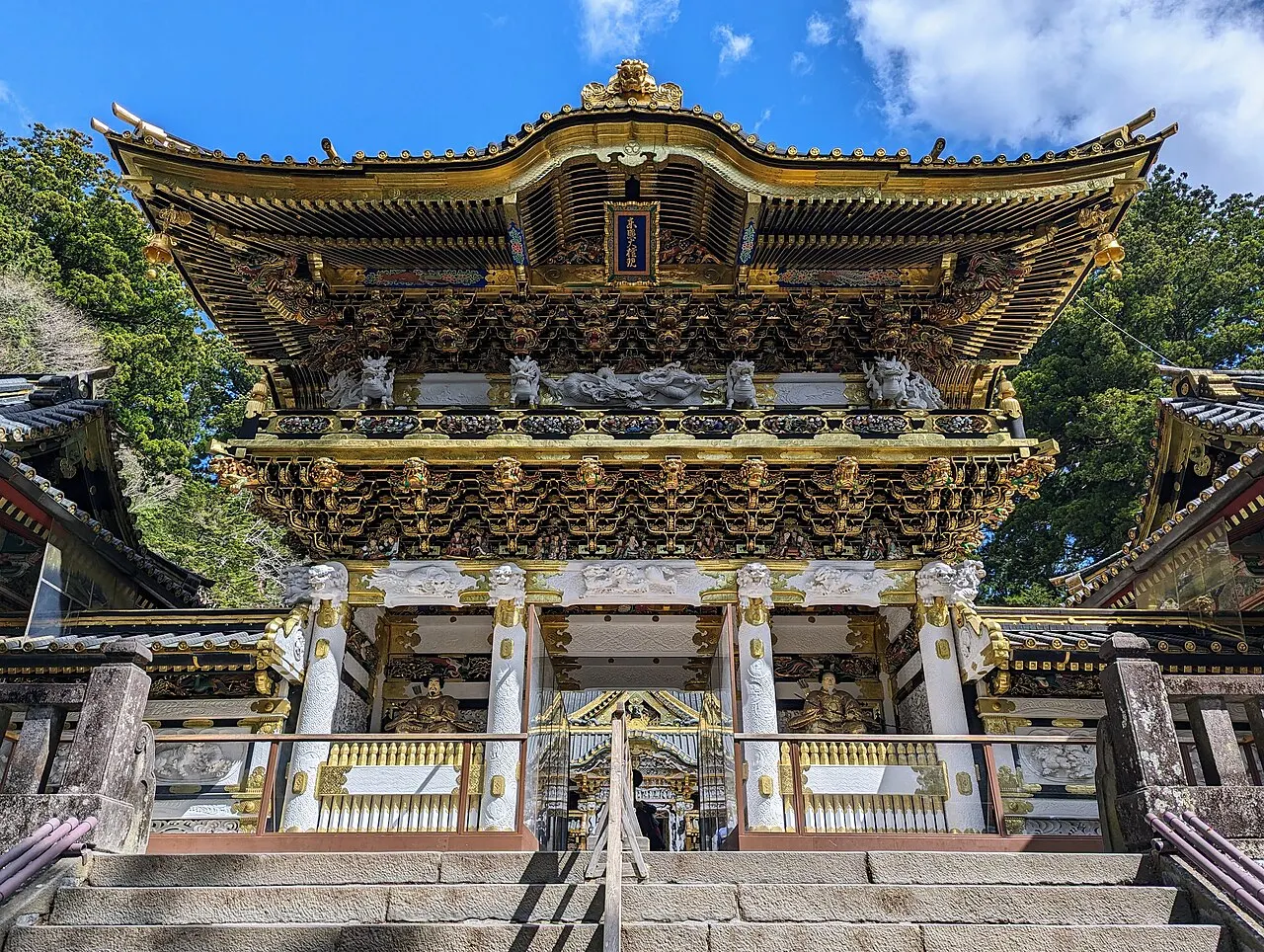
The simplicity of the temple buildings near the Sanbutsudō contrasts sharply with the elaborate carvings, lacquered walls, and gilded, polychrome ornamentation of the Taiyūin Mausoleum, which is located farther up the mountain.
The Taiyūin Mausoleum is the final resting place of the third Tokugawa shogun, Iemitsu (1604–1651). Iemitsu had it built near the mausoleum of his grandfather, Ieyasu (1543–1616), which is at Tōshōgū Shrine. In Iemitsu’s time, centuries prior to the separation of Shinto and Buddhism, Tōshōgū and Rinnōji were considered part of the same institution. Indeed, the funerary services for Ieyasu were conducted by Tenkai (1536?–1643), the fifty-third abbot of Nikkōzan, in the sannō ichijitsu shintō style—a rite that mixes Shinto and Buddhism.
Evidence of the historical melding of Shinto, Buddhism, and mountain worship can still be seen throughout Nikkō. For example, the three mountains of Mt. Nantai, Mt. Nyohō, and Mt. Tarō are said to be manifestations of Rinnōji’s three principal deities: Senju Kannon (Thousand-Armed Bodhisattva of Compassion), Amida Nyorai (Buddha of Infinite Light and Life), and Batō Kannon (Horse-Headed Bodhisattva of Compassion), respectively. The Shinto counterparts of these three Buddhist deities are venerated at Futarasan Jinja Shrine.
Rinnōji is part of the Shrines and Temples of Nikkō, which was designated a UNESCO World Heritage Site in 1999. The Rinnōji complex contains one National Treasure, 37 Important Cultural Properties, and four Prefectural Tangible Cultural Properties.
出典: 地域観光資源の多言語解説文データベース(観光庁) — www.mlit.go.jp/tagengo-db. この英語解説文は観光庁の地域観光資源の多言語解説整備支援事業で作成しました。
Source: Japan Tourism Agency, Multilingual Explanation Database. This English text was produced by the Japan Tourism Agency's multilingual explanation project and is shown unedited. Opening hours and services may have changed since it was written.
旅Nikkō tours
Live prices and reviews from GetYourGuide. Many tours can be cancelled for free — check each listing.
Ad: we may earn a commission if you book through these links, at no extra cost to you.
Treasure hunts nearby
Getting there
Stay in Nikkō or Kinugawa Onsen
Ad: we may earn a commission if you book through these links, at no extra cost to you.
More temples in Tochigi
Open the scanner and compare →