Kaguraden (Sacred Dance Hall) 神楽殿
Official explanation
The Kaguraden is a ceremonial space designed to host large group rituals, weddings, and performances. The hall was first built in 1667, but was rebuilt in its current form in 1981 to commemorate the centennial of Izumo Ōyashiro-kyō, a religious organization that promotes worship of the shrine’s main deity, Ōkuninushi no Kami.
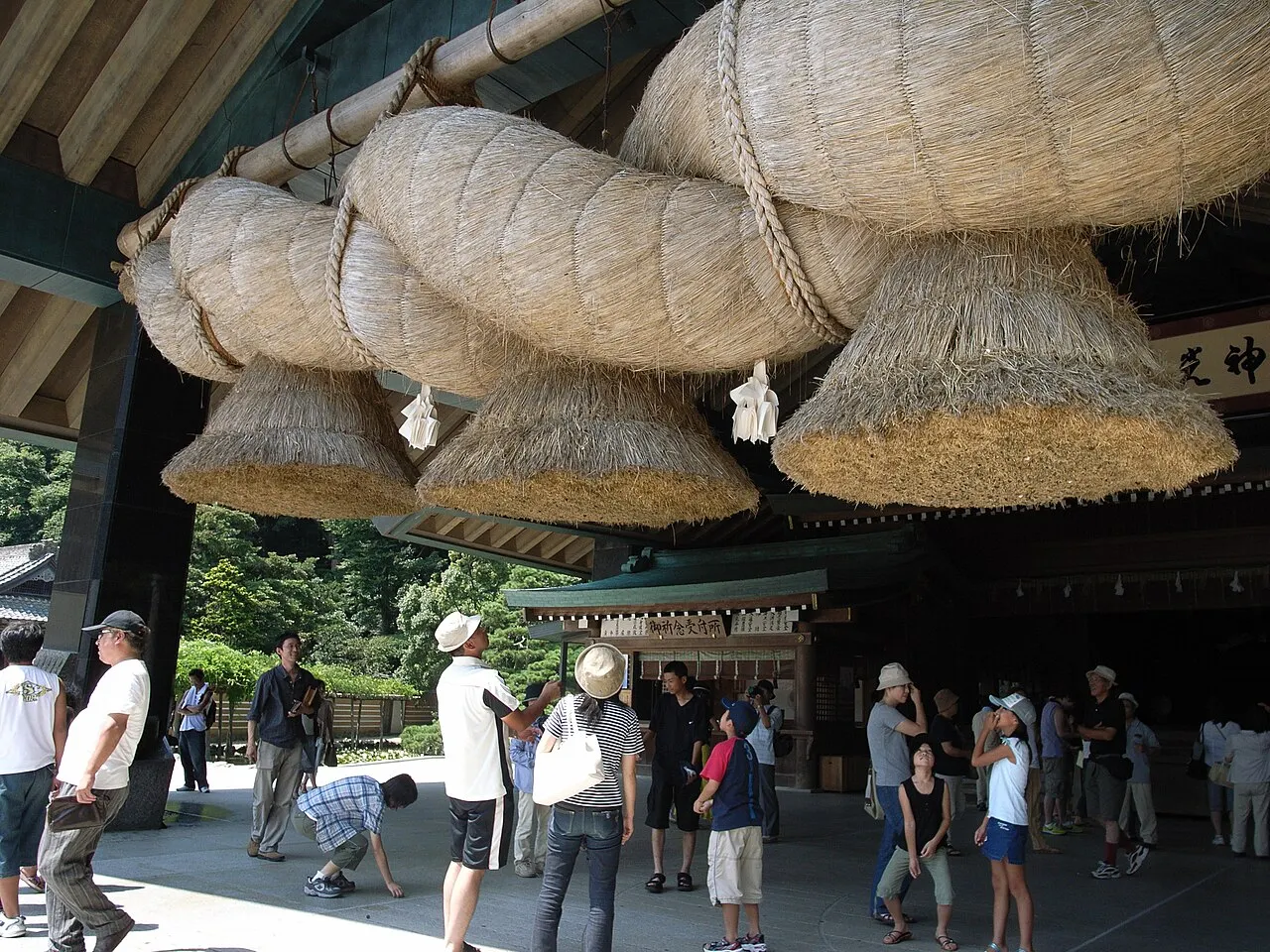
A massive straw rope known as the “Ō-shimenawa” hangs in front of the Kaguraden. It is the largest in Japan, measuring 13.6 meters in length, 8 meters in girth, and weighing 5.2 metric tons. Shimenawa are sacred straw ropes that mark the boundary between sacred and profane space. The various shimenawa at Izumo Ōyashiro are unique in that the two strands forming the rope are twisted together beginning on the left (facing the hall), while those at other shrines begin on the right. The direction can be told from the bluntness of the rope ends on the left, compared to the narrower, tapering ends on the right. The Kaguraden’s great shimenawa is replaced every six to eight years and is woven by a group of volunteers from Iinan in central Shimane Prefecture.
Read the full explanation
Passing under the shimenawa, visitors will see a large stained-glass window depicting the shrine crest and the multi-colored clouds symbolic of Izumo. This is a rare sight, as stained glass is not typical of shrine architecture.
Despite its name, the Kaguraden of Izumo Ōyashiro does not hold performances of kagura (sacred dance). Instead, it was originally constructed as a venue for unique rituals passed down through the shrine’s family of chief priests (kokusō). Today, the Kaguraden hosts weddings and prayer services for the general public.
The Kaguraden is a ceremonial space that hosts large group rituals, weddings, and performances. Kagura, which means “entertainment for the gods,” is a type of Shinto ritual dance that can be traced back to the early ninth century. Despite the name, kagura performances are not held in Izumo Ōyashiro Shrine’s Kaguraden. Instead, it was originally built to conduct unique sacred rituals passed down through the shrine’s family of chief priests (kokusō). Today, the Kaguraden hosts weddings and prayer services for the general public.
The Kaguraden’s most prominent feature is the massive shimenawa rope (the “Ō-shimenawa”) that hangs above the entrance to the hall. Measuring 13.6 meters in length, 8 meters in girth, and weighing 5.2 metric tons, it is the largest in Japan. Shimenawa are braided straw ropes that designate Shinto sacred spaces. The shimenawa at Izumo Ōyashiro are twisted together beginning on the left (as one faces the hall), as evidenced by the bluntness of the rope ends on the left, compared to the narrower, tapering ends on the right. This feature is peculiar to Izumo; at most other shrines, the ropes begin on the right side. The Kaguraden’s shimenawa is replaced every six to eight years and is woven by a group of volunteers from Iinan in central Shimane Prefecture.
Behind the shimenawa hangs a large, framed piece of calligraphy proclaiming, “Filled with the light of Ōkuninushi” (shinkō manden). Above the doors to the hall, visitors will see a large stained-glass window decorating the gable. It depicts the shrine crest and the multi-colored clouds that symbolize Izumo. Stained glass is not typically used in shrine architecture, so this is a rare example.
The Kaguraden was first built in 1667, but was rebuilt in its current form in 1981 to commemorate the 1982 centennial of Izumo Ōyashiro-kyō, a religious organization that promotes the worship of Ōkuninushi no Kami. The organization was founded in 1882 by Senge Takatomi (1845–1918), the 80th chief priest (kokusō) of Izumo Ōyashiro. With its own set of teaching principles known as “Izumo Shinto,” Izumo Ōyashiro-kyō was one of the original 13 sects of Shinto recognized by the government during the Meiji era (1868–1912). While the shrine and Izumo Ōyashiro-kyō are separate entities, the two organizations work together closely.
出典: 地域観光資源の多言語解説文データベース(観光庁) — www.mlit.go.jp/tagengo-db. この英語解説文は観光庁の地域観光資源の多言語解説整備支援事業で作成しました。
Source: Japan Tourism Agency, Multilingual Explanation Database. This English text was produced by the Japan Tourism Agency's multilingual explanation project and is shown unedited. Opening hours and services may have changed since it was written.
旅Izumo & Matsue tours
Live prices and reviews from GetYourGuide. Many tours can be cancelled for free — check each listing.
See all Izumo & Matsue tours →
Ad: we may earn a commission if you book through these links, at no extra cost to you.
Things you may see here
 Shimenawa注連縄
Getting there
Hotels in Shimane
Ad: we may earn a commission if you book through these links, at no extra cost to you.
More sites in Shimane
Open the scanner and compare →