Ikikoku Museum 一支国博物館
Official explanation
The exhibits in the Ikikoku Museum explain the history of the vibrant ties between Iki and mainland Asia from around 200 BCE until the seventh century. During this period, the island was first a self-governing kingdom with Harunotsuji as its capital and then became a key foothold for the Yamato court’s ambitions on the Korean Peninsula.
The museum building stands on a hill overlooking the site of the ancient settlement of Harunotsuji. It was designed by Kurokawa Kisho (1934–2007) to be a natural extension of the historic site, which is visible in its entirety from the museum’s rooftop terrace and observation tower.
Read the full explanation
The permanent exhibition begins with an immersive display highlighting the text of the Book of Wei, part of the third-century Chinese historical text Records of the Three Kingdoms. This chronicle contains the first written mention of Iki, in the form of an account of a Chinese envoy’s journey to the Japanese islands. The introductory section is followed by a video explanation of life in ancient Iki and Harunotsuji; the settlement site can be viewed from the theater room after the film.
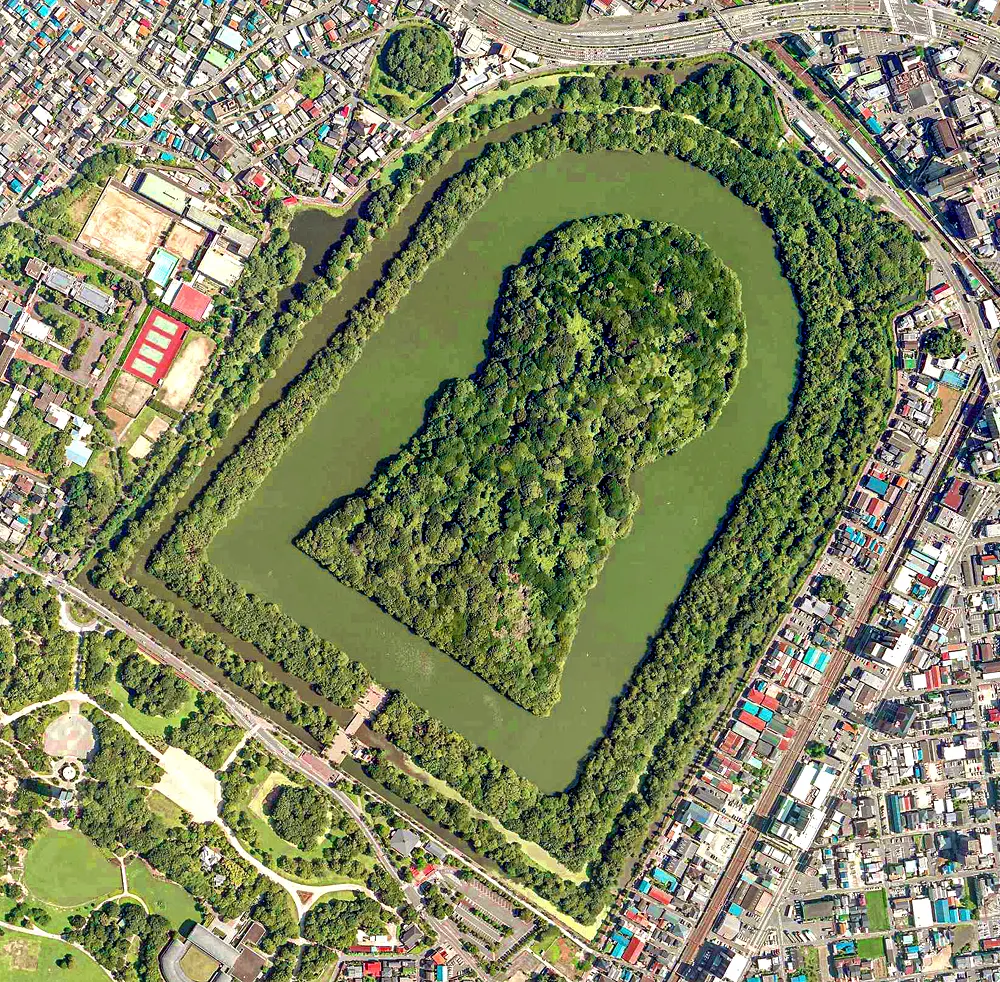
From the theater room, a corridor lined with displays focusing on specific items excavated from the Harunotsuji site and from kofun burial mounds throughout Iki leads down toward the main exhibition space. Many of the items displayed in the corridor can be handled by visitors, and they are placed on low shelves so that they are easy for children to view.
The main exhibition centers on a diorama of life in Harunotsuji, which features figures whose facial features are modeled on those of present-day Iki residents. The scenes depicted include diving for shellfish, the building of pit dwellings, and rituals conducted at the king’s court. There is a full-sized reproduction of a semi-composite boat, which is a dugout with vertically attached planking on each side for protection against waves. The traders of Iki traveled to the Korean Peninsula and Kyushu in such boats to trade their seafood and farm produce for tools, pottery, and weapons.
The museum hosts four or five special exhibitions annually. Part of the storage facility can be viewed through a giant picture window, and visitors can peek into a hall where museum staff clean and restore artifacts. The Nagasaki Prefectural Archaeological Center is in the same building.
出典: 地域観光資源の多言語解説文データベース(観光庁) — www.mlit.go.jp/tagengo-db. この英語解説文は観光庁の地域観光資源の多言語解説整備支援事業で作成しました。
Source: Japan Tourism Agency, Multilingual Explanation Database. This English text was produced by the Japan Tourism Agency's multilingual explanation project and is shown unedited. Opening hours and services may have changed since it was written.
旅Kyūshū tours
Live prices and reviews from GetYourGuide. Many tours can be cancelled for free — check each listing.
Ad: we may earn a commission if you book through these links, at no extra cost to you.
Things you may see here
 Kofun古墳
Getting there
Hotels in Nagasaki
Ad: we may earn a commission if you book through these links, at no extra cost to you.
More museums in Nagasaki
Open the scanner and compare →