Shoboji Temple 正法寺
Official explanation
Shoboji is a well-preserved example of seventeenth-century temple architecture with noteworthy statues, paintings, and scenic gardens. This Buddhist temple was established in 1191 as the memorial temple of the Shimizu family by an ancestor who was a retainer of Minamoto Yoritomo (1147–1199), the founder of the Kamakura shogunate. From 1546, Shoboji was also tasked with the duty of praying for the safety and prosperity of the country by decree of Emperor Go-Nara (1497–1557).
Shoboji benefited greatly from the generosity of Okame no Kata (1576–1642), a daughter of the Shimizu family who became a consort of Tokugawa Ieyasu (1543–1616), the first Tokugawa shogun. The main hall, the larger abbot’s quarters, and the karamon gate were built in 1630 with donations from Okame and are nationally designated Important Cultural Properties. The main hall houses a statue of Amida Buddha from the Kamakura period (1185–1333) as the principal object of worship, and its painted wooden interior still mostly retains its original colors. The larger abbot’s quarters and the drawing room contain classical Chinese and nature-themed paintings on sliding doors, and the rear garden of the temple is a Place of Scenic Beauty designated by Kyoto Prefecture. A large statue of Amida Buddha that once was enshrined in the octagonal Hakkakudo hall nearby was moved to the Ho’unden hall at Shoboji for safekeeping in 2008.
Read the full explanation
The temple is usually not open to the public, but visiting is possible several times a year on special occasions.
Shoboji was established in 1191 as the memorial temple of the Shimizu family by an ancestor who was a retainer of Minamoto Yoritomo (1147–1199), the founder of the Kamakura shogunate. From 1546, the temple was also singled out by decree of Emperor Go-Nara (1497–1557) to pray for the safety and prosperity of the country. Today, Shoboji is a well-preserved example of seventeenth-century temple architecture with noteworthy statues, paintings, and scenic gardens.
The temple benefited greatly from the generosity of Okame no Kata (1576–1642), a daughter of the Shimizu family who became a consort of Tokugawa Ieyasu (1543–1616), the first Tokugawa shogun. A local legend claims that Okame caught Ieyasu’s eye when he saw her lift a heavy tub in which she had been bathing her child to make way for the shogun’s procession. After Okame bore Ieyasu a healthy son, she gained the standing to help support her family temple and secure patronage from the powerful Tokugawa shogunate.
The main hall, the larger abbot’s quarters, and the karamon gate were built with donations from Okame in 1630 and are nationally designated Important Cultural Properties. The main hall houses a statue of Amida Buddha from the Kamakura period (1185–1333) as the principal object of worship, and Buddhist memorial tablets for Okame and her Tokugawa descendants are also kept here. The hall’s wooden interior retains much of its original colorful appearance, including paintings done by one of the artists who worked on Nikko Toshogu, the lavish mausoleum complex of Tokugawa Ieyasu. The nameplate on the building was carved based on the calligraphy of Emperor Go-Nara himself.
The larger abbot’s quarters and the drawing room next to the main hall contain classical Chinese and nature-themed paintings on sliding doors, and the rear garden of the temple is a Place of Scenic Beauty designated by Kyoto Prefecture. A large statue of Amida Buddha that once was enshrined in the octagonal Hakkakudo hall nearby was moved to the Ho’unden hall at Shoboji for safekeeping in 2008.
The temple is usually not open to the public, but visiting is possible several times a year on special occasions.
There are many Buddhist statues enshrined at Shoboji Temple, and the most unusual is a sculpture of Kannon, the bodhisattva of compassion, with three faces. The temple is also well known for a dry landscape garden with rocks that represent animals, and for a series of painted screens depicting the Nishiyama mountains on the western side of Kyoto. Shoboji is located near Oharano Jinja Shrine and belongs to the Toji branch of the Shingon school of Buddhism.
Hoshoen Garden and Hoshoden Hall
The Hoshoen is a combination of a dry landscape garden and a pond-viewing garden. The view extends beyond the outer wall to encompass the Kyoto cityscape and Higashiyama mountains, incorporating them as “borrowed scenery” (shakkei). The shapes of the stones placed in the carefully raked white sand and around the pond resemble birds and animals, giving the garden its other name, “rock garden of birds and beasts.” A total of 16 stones represent 16 different animals from around the world, including a lion, a frog, and even a penguin. A picture guide in the Hoshoden Hall helps visitors find and identify them all. The ever-changing garden invites quiet contemplation with its weeping cherry tree that blooms pink in spring, lush green moss and water lilies in summer, brightly colored maple leaves in autumn, and white snow in winter.
The Hoshoden Hall facing the garden contains a statue of Aizen Myo-o, a Wisdom King depicted with six arms and three eyes, who is believed to grant strong relationships and marital harmony. A relatively rare sculpture of a running Daikokuten, one of the Seven Gods of Fortune, portrays the deity in mid-stride, as if hurrying to bring happiness to people.
Hondo (Main Hall)
The largest statue on the altar is the principal object of worship, Sanmen Senju Kannon. This image of a thousand-armed Kannon has three faces to represent the bodhisattva’s ability to watch over the present, the past, and the future. The gold-plated wooden sculpture is 1.8 meters tall and dates to the early Kamakura period (1185–1333). It is a nationally designated Important Cultural Property.
To the right is a statue of Kannon in a human form. It is called Sho Kannon and is the oldest sculpture in Shoboji. The Shingon school founder Kukai (Kobo Daishi, 774–835) is said to have carved it when he was 42, hoping to protect himself from misfortune at an age traditionally considered inauspicious in a man’s life. Further right is a Muromachi-period (1336–1573) sculpture of Dainichi, the cosmic Buddha. To the left of Sanmen Senju Kannon are two statues of Amida, the Buddha of Infinite Light and Life, also carved in the Muromachi period. Visitors can press a button near the prayer area to hear explanations in Japanese, or read the English leaflet posted in the hall.
Sliding Screen Paintings
The Oharano-born artist Nishii Sayoko (1947–2000) was commissioned to paint 41 sliding screens for the temple’s shoin reception rooms with scenes of the Nishiyama landscape. She managed to finish 17 pieces while fighting a terminal illness, and the rest were completed based on her sketches. The Ode to Nishiyama painted screens are a manifestation of Nishii’s love for her hometown, depicting seasonal flowers, plants, and mountains covered with spring greenery.
Fudodo Hall and Temple Grounds
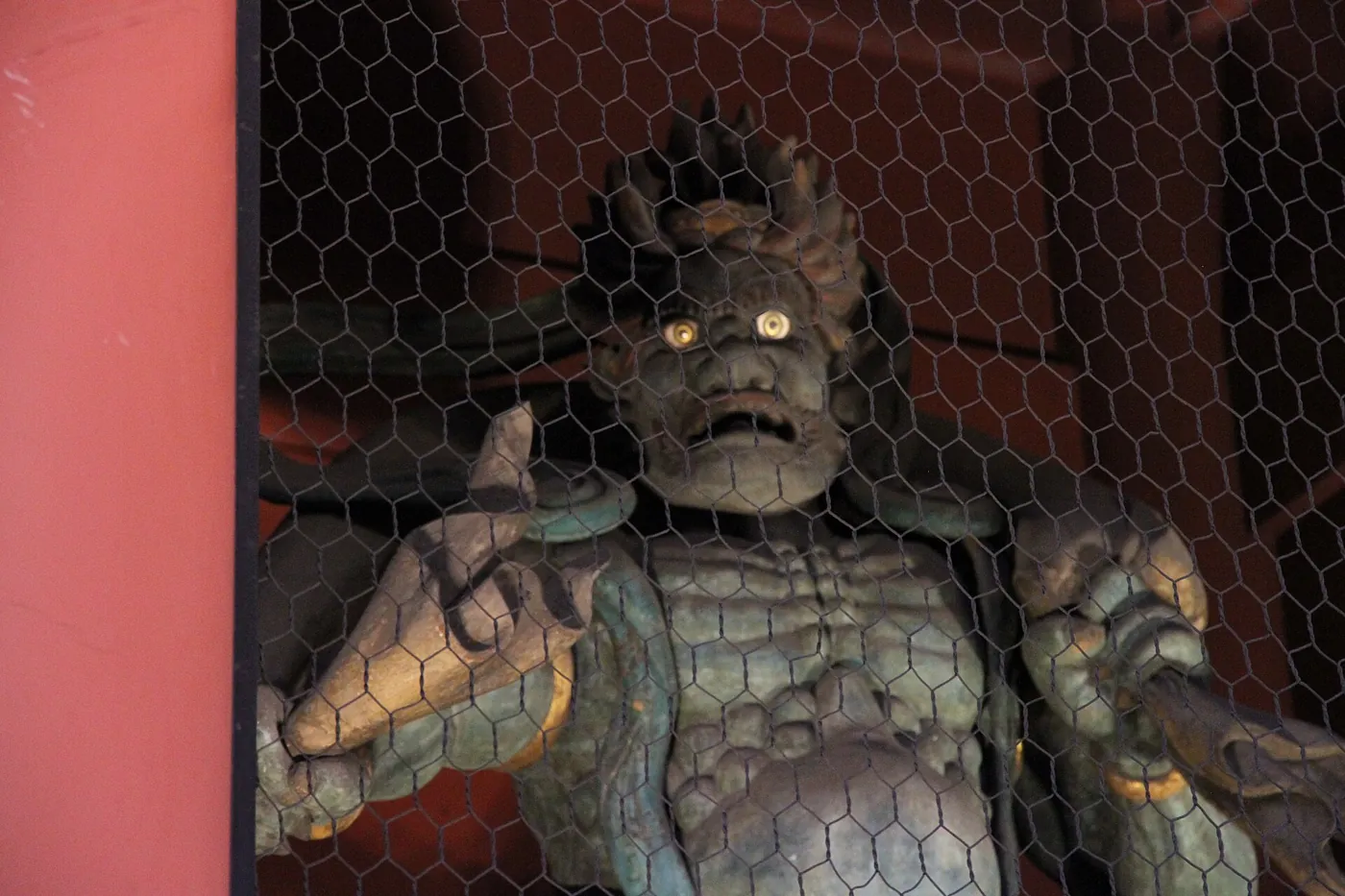
At the top of a flight of stairs flanked by two Nio guardian statues is the Fudodo Hall. It enshrines Kasuga Fudo Myo-o, the Immovable Wisdom King, who is believed to grant safety and prosperity, recovery from illness, and protection from evil. The hall provides a good vantage point to take in the surroundings, including the vermilion Henjoto Pagoda. Behind the Fudodo is Kasuga Inari Shrine, where people pray for commercial success and prosperity. An arched red bridge past the shrine leads to a small waterfall.
Another dry landscape garden lies between the temple’s main gate and the Hondo. On the hillside beyond the gate is an ume plum orchard with more than 100 trees. They bloom white and pink from February to mid-March with the Higashiyama mountain range in the distance and attract many birds, including Japanese white-eyes (mejiro).
Brief History
In the eighth century, the Chinese monk Chii Daitoku came to Japan to help propagate Buddhism. He built a hermitage called Kasuga Zenbo in Oharano in 754 to pursue his ascetic practices. Around the year 800, Saicho (Dengyo Daishi, 767–822), the founder of Japan’s Tendai school of Buddhism, made Kasuga Zenbo a subtemple of a larger temple that he established for protection of the Nagaokakyo area. Like most structures in Kyoto, the temple burned down during the Onin War (1467–1477), but was restored in 1615 and renamed Shoboji. Later, it was expanded with substantial contributions from Keishoin (1627–1705), mother of the fifth Tokugawa shogun, Tsunayoshi.
Shohoji Temple
Shohoji Temple stands at the base of verdant Mt. Buppoji and enshrines Amida Buddha, the Buddha of Infinite Light and Life. In autumn, maple trees throughout the grounds of this Zen Buddhist temple turn vivid shades of red, particularly around the entrance.
History
Temple legend states that Shohoji was founded in 744 near the tomb of Prince Asaka (728–744) to memorialize the young prince. The founder, Gyoki (668–749), was a prominent monk who travelled the country spreading Buddhism and supporting public works projects. Though the temple was once a large mountaintop complex, it fell into disrepair during a period of civil unrest in the early fourteenth century.
In the mid-seventeenth century, Shohoji was reconstructed on a smaller scale at the foot of the mountain by the Tamura family, then lords of Bukkoji Castle. At their request, the head priest of Eigenji Temple, Nyosetsu Mongan (1601–1671), revived Shohoji as an Eigenji school temple, part of the Rinzai sect of Zen Buddhism. One of the temple’s important sponsors was Tokugawa Masako (Tofukumon’in, 1607–1678), who had been granted Wazuka estate lands upon her marriage to Emperor Go-Mizuno’o.
Temple Grounds
The main gate and the Buddha Hall are designated Tangible Cultural Properties of Kyoto Prefecture. The gate was originally donated by Tokugawa Masako from the Kyoto Sento Imperial Palace; the Buddha Hall can be dated to the mid-seventeenth century reconstruction. Inside the Buddha Hall is a seated statue of Amida Buddha that was likely made in the Edo period (1603–1867).
To the right of the Buddha Hall is a small hall for the worship of a deity important to the Koshin folk religion, which combines Taoism, Shinto, Buddhism, and other traditions. Next to the Koshin Hall is a relatively new set of twelve round-faced statues of the bodhisattva Jizo, each one posed with a different Chinese zodiac animal. Up a small flight of stairs is a Jizo Hall containing another statue of Jizo, who is venerated as a guardian of travelers and children.
The main hall is generally closed to the public, but those who wish to enter may inquire with temple staff. A statue of Sei Kannon, the bodhisattva of compassion, is enshrined within. Tokugawa Masako is said to have prayed to this statue in her palace quarters before it was given to Shohoji.
Seasonal Beauty
The path to the temple is lined with lush maple trees thought to have been donated by Eigenji, the head temple in Shiga Prefecture known for its fall scenery. Here, the leaves turn brilliant shades of red and orange in autumn, and a large ginkgo tree adds touches of bright yellow. In other seasons, small patches of flowers bloom throughout the precincts, including azalea, iris, and sal trees (Shorea robusta).
Access
Walk approximately 8 minutes from the Wazukayama-no-Ie bus stop, taking a left at the large intersection.
Shohoji Temple
Shohoji, a Zen Buddhist temple at the base of Mt. Buppoji, is a popular autumn foliage viewing spot. In November, maple trees on the grounds turn vivid shades of orange and red, particularly around the entrance. At various times of year, azalea, iris, sal trees (Shorea robusta), and other plants add color to the tree-covered hill.
According to legend, Shohoji was founded in 744 and dedicated to the repose of Prince Asaka (728–744) after he was buried nearby. The current temple was built in the mid-seventeenth century by the Tamura family, who were the lords of Bukkoji Castle, and supported by the empress Tokugawa Masako (Tofukumon’in, 1607–1678), who was granted Wazuka estate lands upon her marriage to Emperor Go-Mizuno’o.
The temple grounds contain two Tangible Cultural Properties designated by Kyoto Prefecture: the main gate, which was relocated from the Kyoto Sento Imperial Palace, and the Buddha Hall, which enshrines a statue of Amida Buddha, the Buddha of Infinite Life and Light. There are also small halls for worshiping a Koshin folk deity and the bodhisattva Jizo, a guardian of travelers and children. Between them are twelve round-faced Jizo statues, each posed with a Chinese zodiac animal.
The main hall houses a statue of Sei Kannon, the bodhisattva of compassion, donated by Tokugawa Masako. Visitors who wish to enter the main hall and venerate the statue should inquire with temple staff.
Access
From the Wazukayama-no-Ie bus stop, turn left at the large intersection and walk approximately 8 minutes.
出典: 地域観光資源の多言語解説文データベース(観光庁) — www.mlit.go.jp/tagengo-db. この英語解説文は観光庁の地域観光資源の多言語解説整備支援事業で作成しました。
Source: Japan Tourism Agency, Multilingual Explanation Database. This English text was produced by the Japan Tourism Agency's multilingual explanation project and is shown unedited. Opening hours and services may have changed since it was written.
旅Kyoto tours
Live prices and reviews from GetYourGuide. Many tours can be cancelled for free — check each listing.
Ad: we may earn a commission if you book through these links, at no extra cost to you.
Things you may see here
 Niō仁王
 Inari foxes稲荷の狐
Treasure hunts nearby
Getting there
Hotels near Kyoto Station
Ad: we may earn a commission if you book through these links, at no extra cost to you.
More temples in Kyoto
Open the scanner and compare →